

Satellite Servicing Market Size, Share & Forecast 2026–2033 | Valued at US$3.1 Billion, Reaching US$6.1 Billion
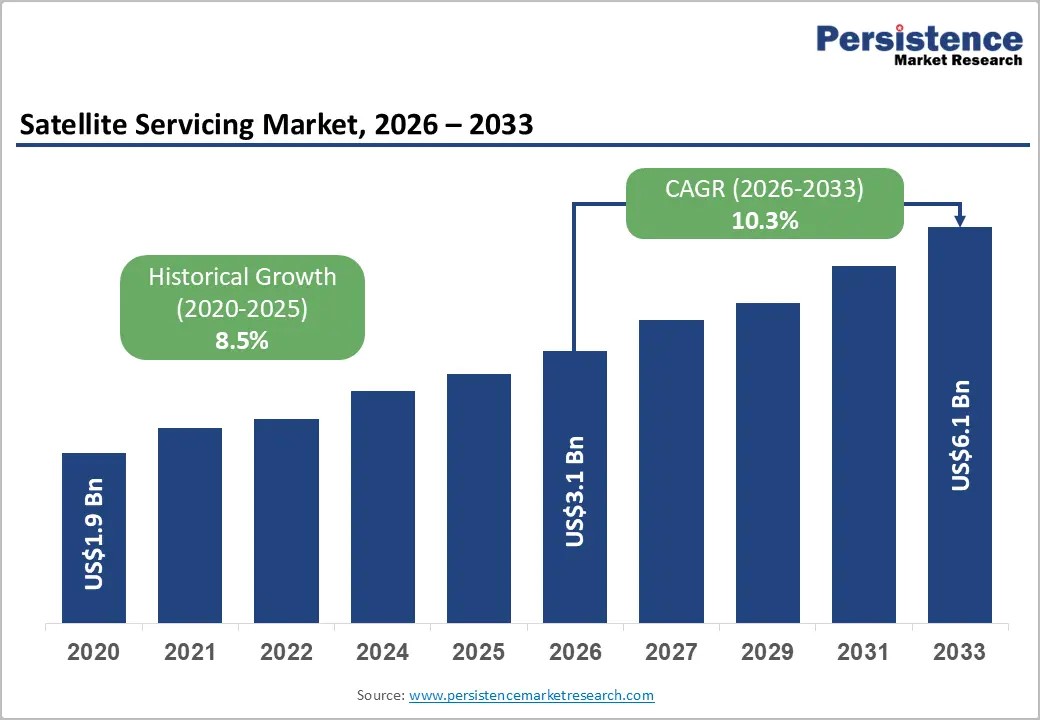
Global Satellite Servicing Market to grow from US$3.1 Bn in 2026 to US$6.1 Bn by 2033, driven by orbital congestion and sustainable space needs
BRENTFORD, ENGLAND, UNITED KINGDOM, July 15, 2026 /EINPresswire.com/ -- The global Satellite Servicing Market is growing rapidly as space operators focus on extending satellite lifespans, reducing replacement costs, and improving orbital sustainability. The market is expected to grow from US$3.1 billion in 2026 to US$6.1 billion by 2033, at a CAGR of 10.3%, driven by rising satellite deployments, orbital congestion, robotic servicing advancements, and government support.
Low Earth Orbit (LEO) is projected to dominate with 84.7% share in 2026 due to increasing satellite constellations requiring maintenance and orbital management. Robotic servicing leads the service segment with 45.8% share, while North America remains the largest regional market with 39.2% share, supported by strong investments, defense programs, and commercial space innovation.
𝐆𝐞𝐭 𝐚 𝐒𝐚𝐦𝐩𝐥𝐞 𝐏𝐃𝐅 𝐁𝐫𝐨𝐜𝐡𝐮𝐫𝐞 𝐨𝐟 𝐭𝐡𝐞 𝐑𝐞𝐩𝐨𝐫𝐭: https://www.persistencemarketresearch.com/samples/36800
Satellite Servicing Market Segmentation
The satellite servicing market is segmented according to orbit, service type, application, and end-user, with each category contributing to the industry's evolving growth landscape. Based on orbit, the market includes Low Earth Orbit (LEO), Medium Earth Orbit (MEO), and Geostationary Earth Orbit (GEO). LEO represents the largest segment because of the massive deployment of communication satellites, Earth observation satellites, and broadband constellations. Thousands of satellites operating within this orbit require continuous orbital adjustments, maintenance, collision avoidance, and end-of-life disposal services, making satellite servicing increasingly essential. Meanwhile, the Medium Earth Orbit segment is expected to witness the fastest growth due to rising investments in navigation satellite systems such as GPS and Galileo, which require long operational lifespans and high reliability.
Based on service type, the market includes robotic servicing, satellite inspection, refueling, repair and maintenance, active debris removal (ADR), orbit adjustment, relocation, and life-extension services. Robotic servicing dominates the market as it enables autonomous and highly accurate operations in space while minimizing mission risks and operational costs. Technologies involving robotic arms, autonomous navigation systems, and artificial intelligence are enabling satellites to be inspected, repaired, refueled, and repositioned without direct human involvement. Active debris removal and orbit adjustment services are also gaining considerable traction as governments and commercial operators seek effective methods to reduce space congestion and comply with increasingly stringent orbital sustainability regulations.
From an end-user perspective, the satellite servicing market serves commercial satellite operators, defense organizations, government space agencies, research institutions, and satellite manufacturers. Commercial satellite operators are increasingly adopting servicing solutions to maximize the return on investments by extending satellite operational lifespans rather than launching expensive replacements. Government and defense agencies continue investing heavily in servicing technologies to ensure uninterrupted communication, surveillance, intelligence, and national security capabilities while improving long-term sustainability of strategic satellite assets.
Regional Insights
North America continues to lead the global satellite servicing market due to its mature aerospace ecosystem, substantial government funding, and strong presence of leading commercial space companies. The United States remains at the forefront of innovation through programs supported by NASA, the Department of Defense, and the U.S. Space Force. Companies including Northrop Grumman, Maxar Technologies, Orbit Fab, and Starfish Space are actively commercializing satellite servicing technologies ranging from life-extension vehicles to autonomous refueling and debris removal systems. Continuous investments in robotic servicing missions and increasing defense-related applications further strengthen North America's dominant position.
Europe is emerging as one of the fastest-growing markets owing to its proactive regulatory framework emphasizing orbital sustainability and responsible satellite operations. The European Space Agency continues funding numerous satellite servicing, debris mitigation, and life-extension initiatives that encourage innovation across member countries. The United Kingdom has become a center for satellite servicing research and small satellite technologies, while Germany contributes through advanced robotics, satellite manufacturing, and precision engineering capabilities that support servicing missions.
The Asia Pacific region is witnessing significant growth as governments increase investments in indigenous space capabilities and satellite infrastructure. Countries including China, India, and Japan are prioritizing satellite servicing technologies as strategic national assets. China's state-funded servicing missions, India's autonomous docking initiatives under ISRO's SPADEX program, and Japan's leadership in active debris removal technologies are collectively driving regional market expansion. As satellite launch activities continue to increase across the region, demand for servicing, maintenance, refueling, and debris removal solutions is expected to accelerate substantially.
𝐃𝐨 𝐘𝐨𝐮 𝐇𝐚𝐯𝐞 𝐀𝐧𝐲 𝐐𝐮𝐞𝐫𝐲 𝐎𝐫 𝐒𝐩𝐞𝐜𝐢𝐟𝐢𝐜 𝐑𝐞𝐪𝐮𝐢𝐫𝐞𝐦𝐞𝐧𝐭? 𝐑𝐞𝐪𝐮𝐞𝐬𝐭 𝐂𝐮𝐬𝐭𝐨𝐦𝐢𝐳𝐚𝐭𝐢𝐨𝐧 𝐨𝐟 𝐑𝐞𝐩𝐨𝐫𝐭: https://www.persistencemarketresearch.com/request-customization/36800
Market Drivers
The satellite servicing market is driven by the growing need to extend satellite lifespans while reducing replacement costs. Increasing satellite launches, rising orbital congestion, and demand for sustainable space operations are encouraging the adoption of refueling, repair, robotic servicing, and debris removal technologies.
Market Restraints
The market is restrained by the technical complexity of autonomous in-orbit servicing, high mission costs, and the lack of standardized servicing interfaces in many existing satellites. These challenges increase operational risks and slow widespread adoption.
Market Opportunities
The development of standardized servicing technologies and growing collaboration between space agencies, satellite manufacturers, and private companies are creating significant growth opportunities. Advances in robotic servicing, modular satellite design, and in-orbit assembly are expected to expand the market in the coming years.
𝐁𝐮𝐲 𝐍𝐨𝐰 𝐭𝐡𝐞 𝐃𝐞𝐭𝐚𝐢𝐥𝐞𝐝 𝐑𝐞𝐩𝐨𝐫𝐭: https://www.persistencemarketresearch.com/checkout/36800
Company Insights
The competitive landscape consists of established aerospace manufacturers alongside emerging space technology companies developing specialized servicing capabilities. Leading organizations continue investing heavily in robotic servicing, autonomous navigation, satellite refueling, debris removal, and life-extension technologies to strengthen their market positions.
Key Players
• Northrop Grumman
• Maxar Technologies
• Astroscale
• Orbit Fab, Inc.
• Thales Alenia Space
• AIRBUS
• Lockheed Martin Corporation
• ClearSpace
Conclusion
The satellite servicing market is evolving as space organizations focus on extending satellite lifecycles, reducing replacement costs, and improving orbital sustainability. Advancements in robotic servicing, autonomous docking, refueling, and debris removal technologies are creating new growth opportunities. Supported by government initiatives, industry partnerships, and rising satellite deployments, the market is expected to witness steady growth through 2033, becoming a key component of the global space infrastructure industry.
Related Reports:
Middleoffice BPO Services Market
Pooja Gawai
Persistence Market Research
+1 646-878-6329
email us here
Visit us on social media:
LinkedIn
Instagram
Facebook
YouTube
X
Legal Disclaimer:
EIN Presswire provides this news content "as is" without warranty of any kind. We do not accept any responsibility or liability for the accuracy, content, images, videos, licenses, completeness, legality, or reliability of the information contained in this article. If you have any complaints or copyright issues related to this article, kindly contact the author above.
