

Computer Room Air Conditioning Market to Reach USD 14.51 Billion by 2034, Registering a CAGR of 12.60% (2026-2034)
CRAC Market
Valued at USD 5.03 billion in 2025, the CRAC market is set for rapid growth, driven by rising data center capacity and increasing cooling requirements.
Expanding cloud infrastructure, higher server densities, and the need for energy-efficient cooling solutions are accelerating demand, with North America leading the global market.”
PUNE, MAHARASHTRA, INDIA, February 10, 2026 /EINPresswire.com/ -- The global CRAC (Computer Room Air Conditioning) market is experiencing strong expansion as the rapid growth of data centers, cloud computing, artificial intelligence, and edge infrastructure drives demand for advanced cooling systems. The market was valued at USD 5.03 billion in 2025 and is projected to grow from USD 5.63 billion in 2026 to USD 14.51 billion by 2034, registering a CAGR of 12.60% during the forecast period. North America dominated the global market with a 35.20% share in 2025, supported by the presence of hyperscale data centers and advanced IT infrastructure.— Fortune Business Insights
CRAC systems are specialized cooling units designed to regulate temperature, humidity, and airflow in data centers and environments housing sensitive electronic equipment. These systems play a crucial role in maintaining operational reliability, preventing overheating, and ensuring optimal performance of IT hardware. As digital transformation accelerates across industries, the need for efficient thermal management solutions continues to grow.
Get Free Sample PDF Here: https://www.fortunebusinessinsights.com/enquiry/request-sample-pdf/crac-market-114498
Market Drivers:
Rising Data Center and IT Infrastructure Demand
The primary driver of the CRAC market is the rapid expansion of digital infrastructure. The growth of cloud computing, artificial intelligence, big data analytics, and enterprise IT systems is leading to a surge in high-density data centers worldwide.
Since data centers operate continuously and generate substantial heat, maintaining precise temperature and humidity levels is critical for equipment reliability and efficiency. As a result, organizations are increasingly investing in advanced, energy-efficient CRAC systems to support continuous operations and minimize hardware failure risks.
Market Opportunities:
Expansion in Emerging Economies
Emerging economies are creating significant growth opportunities for CRAC system providers. Rapid digitalization, increasing cloud adoption, and government-supported IT infrastructure projects are fueling the demand for advanced cooling solutions.
Countries in Asia Pacific, the Middle East, and Latin America are witnessing the construction of hyperscale and edge data centers, creating a strong need for reliable thermal management systems. This trend enables manufacturers to expand their presence and introduce energy-efficient solutions tailored to the requirements of fast-growing digital ecosystems.
Market Trends:
Shift Toward Energy-Efficient and Smart Cooling Systems
One of the most prominent trends in the CRAC market is the transition toward energy-efficient and intelligent cooling technologies. With data centers consuming significant amounts of electricity, improving cooling efficiency has become a top priority.
Modern CRAC systems incorporate advanced features such as variable-speed fans, smart sensors, and precision airflow management. These innovations help reduce energy consumption, lower operational costs, and support sustainability goals.
Manufacturers are also developing green cooling solutions aligned with global energy-efficiency standards, making next-generation CRAC systems more attractive to data center operators.
Market Challenges:
Rising Energy Demand and Cooling Complexity
The increasing density of IT workloads, especially from AI and high-performance computing (HPC), is creating new challenges for cooling systems. As servers generate more heat, traditional cooling approaches may become less effective or more energy-intensive.
Data center operators must balance cooling performance, energy efficiency, and cost, while also meeting environmental regulations. The shift toward liquid cooling and hybrid solutions is adding complexity to infrastructure planning and system integration.
Segmentation Analysis:
By Type
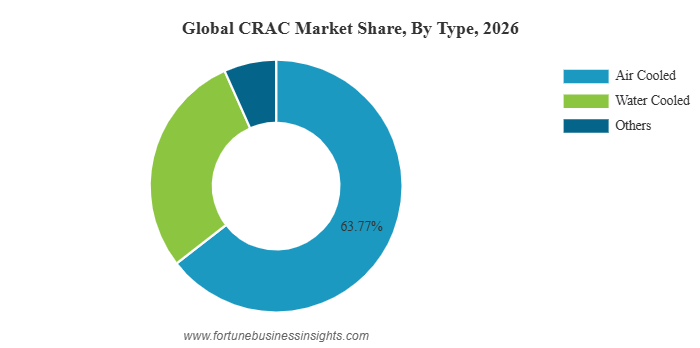
The market is segmented into air-cooled, water-cooled, and others.
The air-cooled segment dominated with a 63.77% share in 2026, driven by lower installation costs and simpler design.
The water-cooled segment is expected to register the highest CAGR of 13.5%, owing to superior efficiency for large-scale and high-density data centers.
By Cooling Technology
Segments include packaged DX, DX with free cooling, water loop DX, close-coupled DX, and others.
The packaged DX segment leads with a 39.08% share in 2026 due to its compact and integrated design.
Close-coupled DX systems are the fastest-growing, supported by their efficiency in high-density IT environments.
By End User
The market is divided into colocation, hyperscale cloud, edge, AI/HPC data centers, and others.
The hyperscale cloud data centers segment leads with a 33.39% share in 2026, driven by massive cooling requirements and high operational budgets.
Edge data centers are projected to grow at the fastest CAGR of 14.1%, fueled by IoT, 5G, and low-latency applications.
Regional Insights:
North America
North America leads the global CRAC market, supported by mature IT infrastructure, hyperscale data centers, and strong adoption of energy-efficient cooling technologies. The regional market reached USD 1.97 billion in 2026, with the U.S. accounting for the majority of demand.
Europe
Europe is witnessing steady growth due to the shift toward advanced cooling technologies and the rise of AI-driven data centers. Countries such as Germany, the U.K., and Italy are key contributors to regional demand.
Asia Pacific
Asia Pacific is the fastest-growing region, with a projected CAGR of 14.8%. Rapid digitalization, expansion of cloud services, and government initiatives supporting IT infrastructure are driving growth across China, India, and Japan.
South America and Middle East & Africa
These regions are experiencing moderate growth due to increasing investments in data centers and digital transformation initiatives. GCC countries are emerging as key markets due to large-scale infrastructure development.
Speak To Analysts: https://www.fortunebusinessinsights.com/enquiry/speak-to-analyst/crac-market-114498
Competitive Landscape:
Airedale
Carrier
Daikin Applied
Delta Electronics
Fujitsu General
Hitachi Cooling & Heating
Johnson Controls
Mitsubishi Electric
Schneider Electric
Vertiv
STULZ
Trane Technologies
Future Outlook:
The global CRAC market is expected to witness robust growth through 2034, driven by the rapid expansion of digital infrastructure, hyperscale data centers, and AI workloads. While high installation costs and energy demands remain challenges, technological advancements in energy-efficient and smart cooling systems are expected to reshape the market.
Ashwin Arora
Fortune Business Insights™ Pvt. Ltd.
+1 833-909-2966
sales@fortunebusinessinsights.com
Legal Disclaimer:
EIN Presswire provides this news content "as is" without warranty of any kind. We do not accept any responsibility or liability for the accuracy, content, images, videos, licenses, completeness, legality, or reliability of the information contained in this article. If you have any complaints or copyright issues related to this article, kindly contact the author above.
