

Demand for Intelligent Prosthetics in South Korea Set for Sustained Growth Through 2036, Reaching USD 112.5 Million
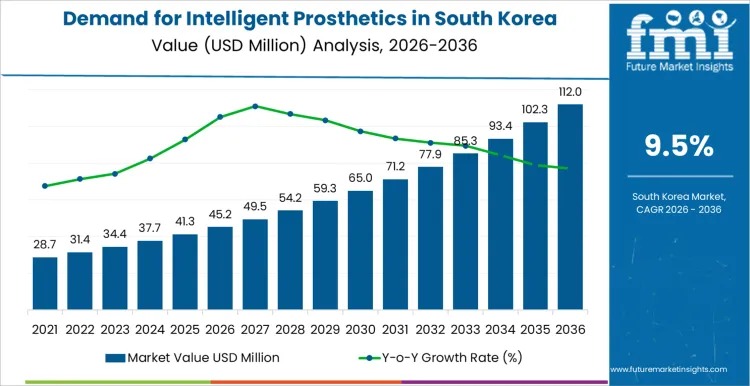
Demand for Intelligent Prosthetics in South Korea
Adoption of intelligent prosthetics in Seoul is growing at a 10.2% CAGR, driven by top hospitals, early adopters and rapid access to global innovations.
NEWARK, DE, UNITED STATES, January 20, 2026 /EINPresswire.com/ -- Demand for intelligent prosthetics solutions in South Korea is entering a sustained growth phase as demographic pressures, government policy, and advanced manufacturing capabilities align. According to the latest industry outlook, the intelligent prosthetics market in South Korea is projected to be valued at USD 45.2 million in 2026 and is forecast to reach USD 112.5 million by 2036, expanding at a compound annual growth rate (CAGR) of 9.5% between 2026 and 2036.
This growth reflects a structural transition in prosthetic care—from passive artificial limbs to active, sensor-driven, and neural-integrated systems—as South Korea positions itself as a global testbed for the convergence of robotics, artificial intelligence, and biomechanics.
Discover Market Opportunities – Get Your Sample of Our Industry Overview Today!
https://www.futuremarketinsights.com/reports/sample/rep-gb-31575
Market Overview: Why Intelligent Prosthetics Are Gaining Strategic Importance
South Korea’s transformation into a super-aged society is reshaping healthcare priorities. Rising incidences of diabetes, vascular disease, and age-related mobility loss are increasing the number of lower-limb amputations, while cultural expectations around active aging are raising demand for prosthetic devices that restore independence rather than basic mobility.
At the same time, the country’s globally competitive semiconductor, battery, and robotics infrastructure is accelerating domestic innovation in assistive technologies. Intelligent prosthetics are increasingly viewed not only as medical devices but as essential mobility technologies aligned with national industrial policy.
Government-backed initiatives, including investments under the “K-Robot” economy, are supporting the standardization and reimbursement of medical bionics, exoskeletons, and smart orthopedic implants within the national healthcare framework.
Quick Market Statistics: Intelligent Prosthetics in South Korea
• Industry Value (2026): USD 45.2 million
• Forecast Value (2036): USD 112.5 million
• Forecast CAGR (2026–2036): 9.5%
• Leading Product Type: Lower Limb Prosthetics (58%)
• Leading Technology: Microprocessor-Controlled Systems (45%)
• Leading End User: Prosthetic Clinics (42%)
• Key Growth Regions: Seoul, Gyeonggi, Busan, Daegu
Technology and Product Trends Reshaping the Sector
Lower Limb Prosthetics Drive Market Volume
Lower limb systems account for 58% of total demand, driven by the high prevalence of diabetes-related and vascular amputations. Patients increasingly prioritize prosthetics that improve balance, energy efficiency, and confidence when navigating South Korea’s urban density and uneven terrain.
The widespread adoption of microprocessor-controlled knees (MPKs) reflects this shift, as these systems dynamically adjust resistance in real time, reducing fall risk and physical strain.
Microprocessor-Controlled Systems Lead on Safety
Microprocessor-controlled prosthetics represent 45% of the technology segment, offering enhanced stability through continuous gait monitoring—often analyzing movement data up to 100 times per second. This responsiveness is particularly critical in dense urban environments where rapid adjustments are needed to prevent stumbles and falls.
Role of Clinics in Adoption and Long-Term Outcomes
Specialized prosthetic clinics account for 42% of end-user demand, outperforming hospitals and general rehabilitation centers. These clinics provide the intensive gait training, device calibration, and long-term follow-up required for intelligent prosthetics.
Many South Korean clinics are now investing in:
• Digital gait analysis laboratories
• Virtual reality–based rehabilitation environments
• Remote tuning and monitoring platforms
This evolution is positioning clinics as comprehensive rehabilitation hubs rather than point-of-sale facilities.
Structural Shifts: Osseointegration and Neural Interfaces
The industry is also witnessing growing interest in osseointegration, where prosthetics attach directly to the skeleton rather than using socket-based systems. This approach improves comfort, range of motion, and sensory feedback for active users, particularly those experiencing chronic socket discomfort.
In parallel, South Korean research institutions are advancing brain–computer interface (BCI) technologies, including non-invasive neural headsets and nerve-cuff electrodes. These systems aim to translate neural signals into prosthetic movement, potentially overcoming the limitations of traditional EMG sensors affected by sweat or muscle fatigue.
Cost and Access Remain Key Constraints
Despite technological progress, cost remains the most significant barrier to widespread adoption. While basic prosthetics are covered under national insurance, advanced bionic hands and powered ankles often require substantial out-of-pocket expenditure. This creates access disparities and underscores the need for:
• Cost-effective domestic manufacturing
• Expanded reimbursement frameworks
• Standardized evaluation of long-term healthcare savings
Regional Growth Patterns Highlight Specialized Ecosystems
• Seoul (CAGR 10.2%) leads adoption due to its concentration of university hospitals, clinical trials, and early adopters of advanced bionic systems.
• Daegu (CAGR 9.8%), branded as “Medicity Daegu,” is emerging as a hub for robotic rehabilitation and domestic device startups.
• Gyeonggi (CAGR 9.1%) benefits from its manufacturing base and Pangyo Techno Valley, where AI software and hardware development converge.
• Busan (CAGR 8.5%) is driven by geriatric care demand, focusing on lightweight, user-friendly intelligent prosthetics for elderly patients.
Competitive Landscape and Industry Structure
The competitive environment is defined by collaboration and cross-industry entry. Established global manufacturers such as Ottobock and Össur compete alongside South Korean conglomerates and robotics specialists, including Hyundai Rotem, Samsung Electronics (Assistive Tech Division), and Cyberdyne.
Key competitive strategies include:
• Partnerships with battery and motor suppliers to improve power-to-weight ratios
• Acquisitions of niche sensor and AI startups
• Development of integrated mobility ecosystems combining hardware, software, and rehabilitation services
Market Scope and Segmentation
By Product Type
• Upper Limb Prosthetics
• Lower Limb Prosthetics
By Technology
• Microprocessor-Controlled
• Myoelectric
• Mechanical/Passive
By End User
• Prosthetic Clinics
• Hospitals
• Rehabilitation Centers
By Region
• Seoul
• Daegu
• Gyeonggi
• Busan
Why FMI: https://www.futuremarketinsights.com/why-fmi
Related Reports Insights from Future Market Insights (FMI)
Exosome-Inspired Plant Vesicles Market https://www.futuremarketinsights.com/reports/exosome-inspired-plant-vesicles-market
Unbranded Generics Market https://www.futuremarketinsights.com/reports/unbranded-generics-market
Encapsulated Vitamin C Market https://www.futuremarketinsights.com/reports/encapsulated-vitamin-c-market
Vaccine Residual Process Reagents Market https://www.futuremarketinsights.com/reports/vaccine-residual-process-reagents-market
About Future Market Insights (FMI)
Future Market Insights, Inc. (FMI) is an ESOMAR-certified, ISO 9001:2015 market research and consulting organization, trusted by Fortune 500 clients and global enterprises. With operations in the U.S., UK, India, and Dubai, FMI provides data-backed insights and strategic intelligence across 30+ industries and 1200 markets worldwide.
Sudip Saha
Future Market Insights Inc.
+1 347-918-3531
email us here
Legal Disclaimer:
EIN Presswire provides this news content "as is" without warranty of any kind. We do not accept any responsibility or liability for the accuracy, content, images, videos, licenses, completeness, legality, or reliability of the information contained in this article. If you have any complaints or copyright issues related to this article, kindly contact the author above.
