

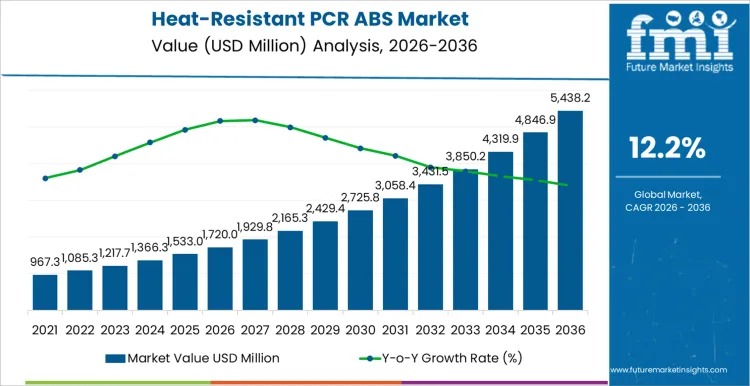
Global Heat-Resistant PCR ABS Market Forecast: USD 1,720.0 Million in 2026 to USD 5,438.2 Million by 2036 at 12.2% CAGR
Heat-Resistant PCR ABS Market
Heat-resistant PCR ABS demand in Germany is rising at 11.4% CAGR as automotive and industrial sectors shift to recycled plastic under EU circular economy rules.
NEWARK, DE, UNITED STATES, January 20, 2026 /EINPresswire.com/ -- The heat-resistant PCR ABS market is poised for substantial growth over the next decade, as manufacturers increasingly adopt recycled ABS materials capable of maintaining thermal and mechanical performance in high-temperature applications. According to the latest market projections, the global heat-resistant PCR ABS market is expected to reach USD 1,720.0 million in 2026, expanding to USD 5,438.2 million by 2036, representing a compound annual growth rate (CAGR) of 12.2%.
This growth reflects the increasing replacement of virgin ABS with heat-stabilised PCR ABS across automotive interiors, consumer electronics, appliances, and industrial components, where dimensional stability, impact resistance, and surface quality under elevated temperatures are critical.
Rising Demand Driven by Automotive and Electronics Applications
The adoption of heat-resistant PCR ABS is primarily fueled by industries where components are exposed to prolonged heat cycles. In automotive interiors, under-hood clips, fuse box housings, instrument panels, and console bezels must withstand cabin heat exceeding 80 °C without deformation or surface degradation. Similarly, electronics OEMs require PCR ABS for handheld devices, speaker enclosures, and appliance housings that endure soldering, reflow processes, and extended operational temperatures.
Discover Growth Opportunities in the Market – Get Your Sample Report Now
https://www.futuremarketinsights.com/reports/sample/rep-gb-31599
Rising Demand for Sustainable, High-Performance Materials
The market expansion is fueled by manufacturers’ increasing preference for heat-stabilised PCR ABS in applications requiring sustained thermal performance. Automotive interiors, consumer electronics housings, and industrial components are relying on recycled ABS grades that maintain dimensional stability, impact strength, and surface quality under elevated temperatures.
• Heat-stabilised PCR ABS enables components to withstand cabin heat, soldering processes, and continuous operating temperatures without deformation or surface degradation.
• OEM sustainability targets are accelerating qualification cycles for PCR ABS across both visible and functional parts.
• Advanced sorting, decontamination, and re-compounding processes ensure consistent melt flow, heat deflection performance, and injection molding reliability.
Material Grades and Performance Technologies Shaping the Market
Market segmentation underscores how material and technology innovations are driving adoption:
Material Grade:
• Heat-stabilised PCR ABS – 55% share, preferred for thermal endurance and mechanical reliability.
• PCR-ABS blends, PCR-ABS/PC-ABS hybrids, and base PCR-ABS – support differentiated cost and performance objectives.
Performance Technology:
• Thermal stabilisers and impact modification – 55% share, maintaining toughness under repeated heat exposure.
• Controlled rheology and ageing resistance, tight thermal stability control, and cost-optimised stabilisation enhance processing consistency and lifecycle reliability.
End-Use Applications:
• Electronics and appliances – 45% share, including housings subjected to internal heat and long operating cycles.
• Small appliances, IT equipment, and precision electronics demand stable thermal and mechanical properties while aligning with sustainability objectives.
Global Growth Dynamics
The adoption of heat-resistant PCR ABS is rising across key manufacturing hubs worldwide, supported by stringent performance requirements and regulatory pressures:
• India: 15.6% CAGR – driven by appliances, EV components, and consumer electronics integrating recycled plastics.
• China: 14.6% CAGR – scaling usage in electronics and automotive platforms with high-volume production and regulatory mandates.
• USA: 11.8% CAGR – growth reflects appliance housings, EV interiors, and electrical enclosures, supported by OEM sustainability roadmaps.
• Germany: 11.4% CAGR – automotive and industrial sectors prioritize compliance with EU circular economy regulations.
• Japan: 10.4% CAGR – high-precision electronics and automotive components require strict dimensional and thermal stability.
Key Market Drivers
• Replacement of virgin ABS in high-temperature applications to meet sustainability goals.
• Rising thermal and mechanical performance expectations in automotive, electronics, and appliances.
• Advanced recycling and compounding processes ensuring feedstock consistency and reliable injection molding.
• Regulatory mandates and OEM sustainability commitments driving recycled content adoption.
Competitive Landscape
Leading players are positioning strategically to capture market share through engineered solutions:
• Lanxess: Engineered PCR ABS compounds delivering controlled heat resistance for automotive and electrical components.
• BASF: Polymer modification expertise stabilizing recycled ABS under thermal stress.
• Avient: Customized PCR ABS formulations emphasizing colorability and processing consistency.
• SABIC: Alignment of recycled ABS compounds with circular polymer programs for appliance and electronics OEMs.
• Toray: Specialty ABS materials focused on thermal performance and surface finish.
Other notable competitors include Mitsubishi Chemical, Kingfa, and Wanhua, with market trends reflecting virgin ABS substitution in heat-sensitive, high-value applications without compromising functional or aesthetic performance.
Market Outlook and Future Prospects
The heat-resistant PCR ABS market is expected to continue expanding as compounders enhance thermal performance, and OEMs prioritize sustainable material integration across high-temperature components. Innovations in thermal stabilisation, impact modification, and feedstock management will remain critical for maintaining parity with virgin ABS, while supporting long-term reliability in demanding automotive, electronics, and appliance applications.
Why FMI: https://www.futuremarketinsights.com/why-fmi
Related Reports Insights from Future Market Insights (FMI)
EV Chassis Megamolding Thermoplastics Market https://www.futuremarketinsights.com/reports/ev-chassis-megamolding-thermoplastics-market
EV Battery Bio-Renewable Thermal Films Market https://www.futuremarketinsights.com/reports/ev-battery-bio-renewable-thermal-films-market
Drug Delivery Succinic Acid Derivatives Market https://www.futuremarketinsights.com/reports/drug-delivery-succinic-acid-derivatives-market
Drought-Resistant Cotton Herbicides Market https://www.futuremarketinsights.com/reports/drought-resistant-cotton-herbicides-market
About Future Market Insights (FMI)
Future Market Insights, Inc. (FMI) is an ESOMAR-certified, ISO 9001:2015 market research and consulting organization, trusted by Fortune 500 clients and global enterprises. With operations in the U.S., UK, India, and Dubai, FMI provides data-backed insights and strategic intelligence across 30+ industries and 1200 markets worldwide.
Sudip Saha
Future Market Insights Inc.
+1 347-918-3531
email us here
Legal Disclaimer:
EIN Presswire provides this news content "as is" without warranty of any kind. We do not accept any responsibility or liability for the accuracy, content, images, videos, licenses, completeness, legality, or reliability of the information contained in this article. If you have any complaints or copyright issues related to this article, kindly contact the author above.
